

The Indian River Lagoon, a biodiverse estuary of crucial habitats that support the Atlantic Ocean, has faced a deluge of stressors causing drastic declines in water quality, habitat availability, and overall health of the lagoon. The increasingly large human population living along the shores of the Indian River Lagoon and the millions of annual visitors add to the pressures on the waterway, contributing to excess nutrients and pollutants through spills of untreated sewage, aging septic systems that do not fully remove contaminants, stormwater runoff of contaminants from lawns and impervious surfaces, dumping from boats, and more.

The Ocean Research & Conservation Association, Inc. (ORCA), founded in 2005 by renowned deep-sea scientist Dr. Edie Widder, conducts rigorous scientific research to identify hotspots of pollutant accumulation to track sources and create actionable change. ORCA’s use of citizen scientists multiplies the amount of work possible, while expanding the reach of our message through the creation of more environmental advocates and stewards. Our ecotoxicity pollution mapping projects generate comprehensive pollution maps to make pollutants visible to the public and resource managers. The intensive array of analytes sampled in the water column and sediment including nutrients, heavy metals, and human tracers produce a complex but holistic view of the environment. There is no singular cause of pollution, and the multiple sources varying geographically across the lagoon create a complex web to untangle.
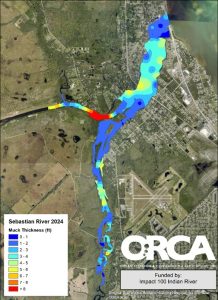
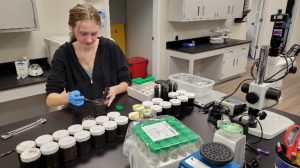
Through the support of Impact 100 Indian River, ORCA was able to create these comprehensive pollution maps of the St. Sebastian River, sampling almost 70 sites within the river. This area has been of interest because despite its relatively low development along the river, it has high water column nutrients identified by both ORCA and the FL Department of Environmental Protection. ORCA currently has two of the maps published on our website, with the remainder available soon. During this project, over 100 students from Sebastian River High School were able to learn and perform ORCA’s actual sediment analysis protocols, gaining experiential education working with actual environmental samples.
ORCA staff have reached out to relevant community organizations to offer presentations about this project, and lectures have already occurred at Sebastian River Fishing Club, Friends of St. Sebastian River, and ORCA’s Lecture Series. More community presentations are in the works, including one at the Environmental Learning Center in late April. There have also been articles in several news sources about the project, prompting more interest. Please reach out to [email protected] if you are part of an organization that is interested in one of these talks.
ORCA has contacted the City of Sebastian, Indian River County, and FL Department of Environmental Protection to share results, gain more knowledge, and get assistance in tracking hotspots. ORCA is planning additional follow-up studies to track pollution sources related to hotspots and make results available to other organizations so that other work can benefit from this baseline of the river’s health. We have already started discussions about restoration efforts within the river based on identified hotspots.

ORCA would like to thank Impact100 for funding this crucial effort to understand this essential freshwater input into the Indian River Lagoon. Improving the health of the lagoon will take many efforts across multiple organizations.
Want to see more of ORCA’s groundbreaking research or become a citizen scientist? Visit teamorca.org to learn more.